
A new digital experience designed for more than 37,000 travel agencies worldwide.
GoGlobal.travel is Yanolja Go Global’s B2B hotel booking platform.
I led its product redesign from research and experience design to launch, experimentation and post launch optimization.
Goglobal.travel
A global platform carrying years of product decisions.
The existing platform served thousands of travel professionals, but its experience had become increasingly difficult to navigate. Finding the right hotel required moving through dense information, pricing was not always easy to understand and the interface no longer reflected the scale of the business.
The challenge was to simplify the experience without disrupting the workflows that experienced users already relied on.




Contents


Home |
The
Challenge
My Role
I led the redesign from discovery through experimentation.
I worked across product strategy, research, UX and delivery, collaborating with users, business stakeholders and the development team.
My responsibilities included:
- User and competitor research
- Product requirements and prioritization
- User flows, wireframes and prototypes
- Search and booking experience design
- Collaboration with developers and QA
- Launch planning and A/B testing
- Behavioral analysis and continuous optimization
Discovery
Designing for professionals who book travel every day.
I spoke with travel agents, observed how employees and customers used the platform and analyzed behavior through Google Analytics and FullStory.
The research revealed where users hesitated, which information they needed to compare options and which parts of the booking journey created unnecessary friction.
I also studied platforms such as Booking.com and Expedia, not to copy their interfaces, but to understand the interaction patterns users already recognized.
The New Experience
Less friction between searching and booking.
The platform was redesigned around the decisions travel agents make every day: where to search, how to compare options and which hotel offers the right value for their customer.
The new experience introduced:
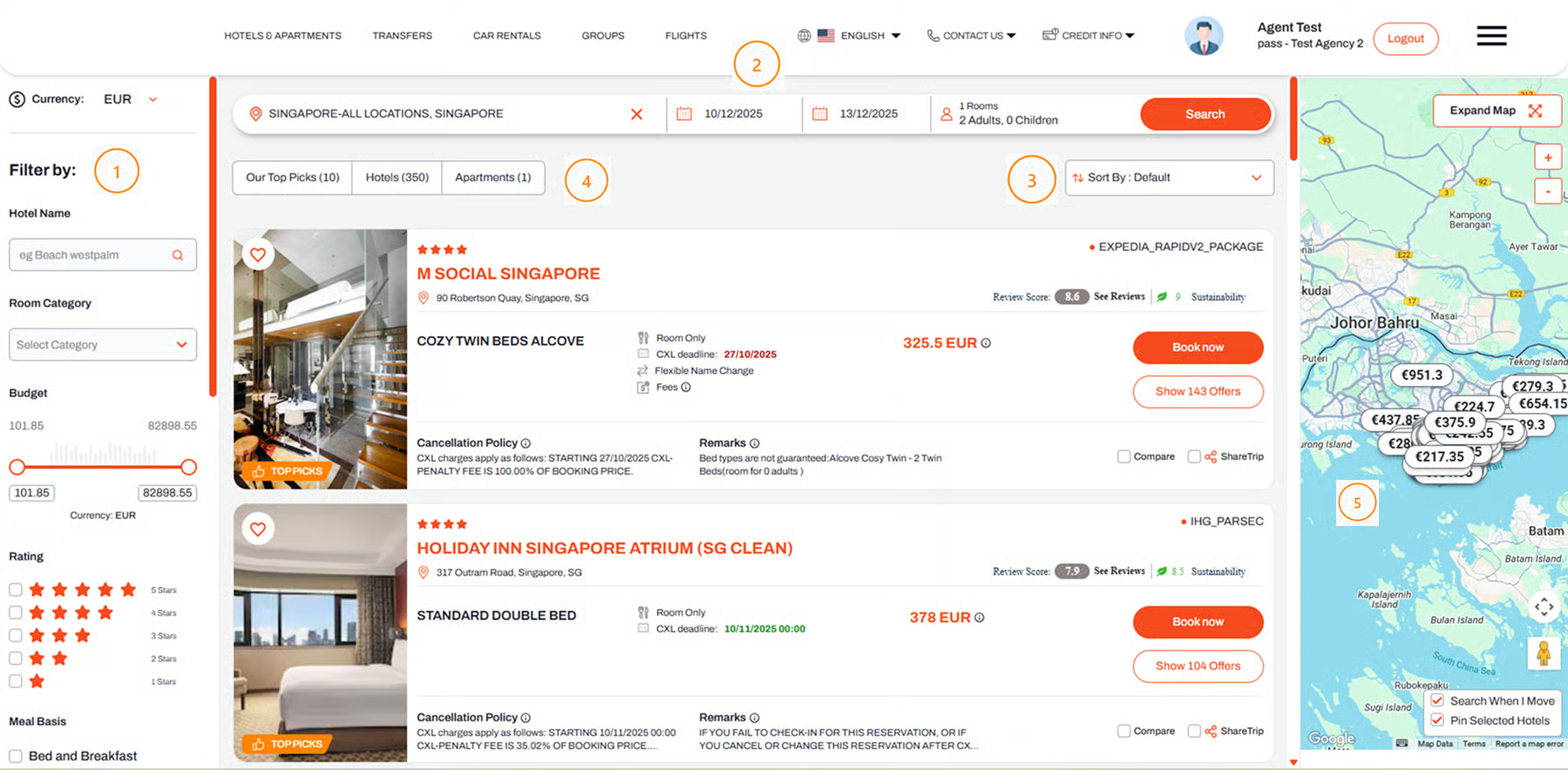
- Clearer search and filtering
- Improved hotel comparison
- More intuitive navigation
- Better presentation of prices and booking conditions
- Redesigned hotel and results pages
- A more effective hotel-sorting experience
- A consistent visual system across the booking journey
Every change had to make the platform easier to use while still supporting the depth expected by professional travel agents.
The Experiment
The first results were negative, and that made the experiment useful.
We launched the new platform through an A/B test against the previous version. During the first days, the new experience performed slightly worse.
Instead of treating the result as a failed redesign, I investigated how users were behaving. Google Analytics and FullStory revealed several points of friction involving UX and pricing presentation.
We corrected the issues within the first week and continued monitoring the experiment.
The Impact
After three weeks, the direction of the experiment had changed.
The optimized platform delivered:
- 8.5% growth in average revenue per user
- 28% increase in time spent on the platform
- Higher-value reservations
- A clearer and more effective booking journey
The overall number of reservations remained similar, but users generated more value through improved discovery, sorting and decision-making.
My role: Product ManagerProduct: Global B2B booking platformUsers: 37,000+ travel agenciesMarkets: WorldwideKey result: 8.5% increase in average revenue per user
We didn’t just redesign how the platform looked. We improved how travel professionals searched, compared and decided.
Reimagining a Global
Booking Platform
A new digital experience designed for more than 37,000 travel agencies worldwide.
GoGlobal.travel is Yanolja Go Global’s B2B hotel booking platform.
I led its product redesign from research and experience design to launch, experimentation and post-launch optimization.
My role: Product ManagerProduct: Global B2B booking platformUsers: 37,000+ travel agenciesMarkets: WorldwideKey result: 8.5% increase in average revenue per user
Goglobal.travel
Reimagining a Global Booking Platform
Contents
The Challenge
A global platform carrying years of product decisions.
The existing platform served thousands of travel professionals, but its experience had become increasingly difficult to navigate. Finding the right hotel required moving through dense information, pricing was not always easy to understand and the interface no longer reflected the scale of the business.
The challenge was to simplify the experience without disrupting the workflows that experienced users already relied on.

My Role
I led the redesign from discovery through experimentation.
I worked across product strategy, research, UX and delivery, collaborating with users, business stakeholders and the development team.
My responsibilities included:
- User and competitor research
- Product requirements and prioritization
- User flows, wireframes and prototypes
- Search and booking experience design
- Collaboration with developers and QA
- Launch planning and A/B testing
- Behavioral analysis and continuous optimization
Discovery
Designing for professionals who book travel every day.
I spoke with travel agents, observed how employees and customers used the platform and analyzed behavior through Google Analytics and FullStory.
The research revealed where users hesitated, which information they needed to compare options and which parts of the booking journey created unnecessary friction.
I also studied platforms such as Booking.com and Expedia, not to copy their interfaces, but to understand the interaction patterns users already recognized.
The New Experience
Less friction between searching and booking.
The platform was redesigned around the decisions travel agents make every day: where to search, how to compare options and which hotel offers the right value for their customer.
The new experience introduced:
- Clearer search and filtering
- Improved hotel comparison
- More intuitive navigation
- Better presentation of prices and booking conditions
- Redesigned hotel and results pages
- A more effective hotel-sorting experience
- A consistent visual system across the booking journey
Every change had to make the platform easier to use while still supporting the depth expected by professional travel agents.
The Experiment
The first results were negative, and that made the experiment useful.
We launched the new platform through an A/B test against the previous version. During the first days, the new experience performed slightly worse.
Instead of treating the result as a failed redesign, I investigated how users were behaving. Google Analytics and FullStory revealed several points of friction involving UX and pricing presentation.
We corrected the issues within the first week and continued monitoring the experiment.
The Impact
After three weeks, the direction of the experiment had changed.
The optimized platform delivered:
- 8.5% growth in average revenue per user
- 28% increase in time spent on the platform
- Higher-value reservations
- A clearer and more effective booking journey
The overall number of reservations remained similar, but users generated more value through improved discovery, sorting and decision-making.
We didn’t just redesign how the platform looked. We improved how travel professionals searched, compared and decided.
Back To Homepage |
The Challenge
My Role
I led the redesign from discovery through experimentation.
I worked across product strategy, research, UX and delivery, collaborating with users, business stakeholders and the development team.
My responsibilities included:
- User and competitor research
- Product requirements and prioritization
- User flows, wireframes and prototypes
- Search and booking experience design
- Collaboration with developers and QA
- Launch planning and A/B testing
- Behavioral analysis and continuous optimization
Discovery
Designing for professionals who book travel every day.
I spoke with travel agents, observed how employees and customers used the platform and analyzed behavior through Google Analytics and FullStory.
The research revealed where users hesitated, which information they needed to compare options and which parts of the booking journey created unnecessary friction.
I also studied platforms such as Booking.com and Expedia, not to copy their interfaces, but to understand the interaction patterns users already recognized.
The New Experience
Less friction between searching and booking.
The platform was redesigned around the decisions travel agents make every day: where to search, how to compare options and which hotel offers the right value for their customer.
The new experience introduced:
- Clearer search and filtering
- Improved hotel comparison
- More intuitive navigation
- Better presentation of prices and booking conditions
- Redesigned hotel and results pages
- A more effective hotel-sorting experience
- A consistent visual system across the booking journey
Every change had to make the platform easier to use while still supporting the depth expected by professional travel agents.
The Experiment
The first results were negative, and that made the experiment useful.
We launched the new platform through an A/B test against the previous version. During the first days, the new experience performed slightly worse.
Instead of treating the result as a failed redesign, I investigated how users were behaving. Google Analytics and FullStory revealed several points of friction involving UX and pricing presentation.
We corrected the issues within the first week and continued monitoring the experiment.
The Impact
After three weeks, the direction of the experiment had changed.
The optimized platform delivered:
- 8.5% growth in average revenue per user
- 28% increase in time spent on the platform
- Higher-value reservations
- A clearer and more effective booking journey
The overall number of reservations remained similar, but users generated more value through improved discovery, sorting and decision-making.
A new digital experience designed for more than 37,000 travel agencies worldwide.
GoGlobal.travel is Yanolja Go Global’s B2B hotel booking platform.
I led its product redesign from research and experience design to launch, experimentation and post-launch optimization.
My role: Product ManagerProduct: Global B2B booking platformUsers: 37,000+ travel agenciesMarkets: WorldwideKey result: 8.5% increase in average revenue per user
Goglobal.travel
Reimagining a Global Booking Platform
Contents
The Challenge
A global platform carrying years of product decisions.
The existing platform served thousands of travel professionals, but its experience had become increasingly difficult to navigate. Finding the right hotel required moving through dense information, pricing was not always easy to understand and the interface no longer reflected the scale of the business.
The challenge was to simplify the experience without disrupting the workflows that experienced users already relied on.

My Role
I led the redesign from discovery through experimentation.
I worked across product strategy, research, UX and delivery, collaborating with users, business stakeholders and the development team.
My responsibilities included:
- User and competitor research
- Product requirements and prioritization
- User flows, wireframes and prototypes
- Search and booking experience design
- Collaboration with developers and QA
- Launch planning and A/B testing
- Behavioral analysis and continuous optimization
Discovery
Designing for professionals who book travel every day.
I spoke with travel agents, observed how employees and customers used the platform and analyzed behavior through Google Analytics and FullStory.
The research revealed where users hesitated, which information they needed to compare options and which parts of the booking journey created unnecessary friction.
I also studied platforms such as Booking.com and Expedia, not to copy their interfaces, but to understand the interaction patterns users already recognized.
The New Experience
Less friction between searching and booking.
The platform was redesigned around the decisions travel agents make every day: where to search, how to compare options and which hotel offers the right value for their customer.
The new experience introduced:
- Clearer search and filtering
- Improved hotel comparison
- More intuitive navigation
- Better presentation of prices and booking conditions
- Redesigned hotel and results pages
- A more effective hotel-sorting experience
- A consistent visual system across the booking journey
Every change had to make the platform easier to use while still supporting the depth expected by professional travel agents.
The Experiment
The first results were negative, and that made the experiment useful.
We launched the new platform through an A/B test against the previous version. During the first days, the new experience performed slightly worse.
Instead of treating the result as a failed redesign, I investigated how users were behaving. Google Analytics and FullStory revealed several points of friction involving UX and pricing presentation.
We corrected the issues within the first week and continued monitoring the experiment.
The Impact
After three weeks, the direction of the experiment had changed.
The optimized platform delivered:
- 8.5% growth in average revenue per user
- 28% increase in time spent on the platform
- Higher-value reservations
- A clearer and more effective booking journey
The overall number of reservations remained similar, but users generated more value through improved discovery, sorting and decision-making.
We didn’t just redesign how the platform looked. We improved how travel professionals searched, compared and decided.
Back To Homepage |
The Challenge
My Role
I led the redesign from discovery through experimentation.
I worked across product strategy, research, UX and delivery, collaborating with users, business stakeholders and the development team.
My responsibilities included:
- User and competitor research
- Product requirements and prioritization
- User flows, wireframes and prototypes
- Search and booking experience design
- Collaboration with developers and QA
- Launch planning and A/B testing
- Behavioral analysis and continuous optimization
Discovery
Designing for professionals who book travel every day.
I spoke with travel agents, observed how employees and customers used the platform and analyzed behavior through Google Analytics and FullStory.
The research revealed where users hesitated, which information they needed to compare options and which parts of the booking journey created unnecessary friction.
I also studied platforms such as Booking.com and Expedia, not to copy their interfaces, but to understand the interaction patterns users already recognized.

The New Experience
Less friction between searching and booking.
The platform was redesigned around the decisions travel agents make every day: where to search, how to compare options and which hotel offers the right value for their customer.
The new experience introduced:
- Clearer search and filtering
- Improved hotel comparison
- More intuitive navigation
- Better presentation of prices and booking conditions
- Redesigned hotel and results pages
- A more effective hotel-sorting experience
- A consistent visual system across the booking journey
Every change had to make the platform easier to use while still supporting the depth expected by professional travel agents.
The Experiment
The first results were negative, and that made the experiment useful.
We launched the new platform through an A/B test against the previous version. During the first days, the new experience performed slightly worse.
Instead of treating the result as a failed redesign, I investigated how users were behaving. Google Analytics and FullStory revealed several points of friction involving UX and pricing presentation.
We corrected the issues within the first week and continued monitoring the experiment.
The Impact
After three weeks, the direction of the experiment had changed.
The optimized platform delivered:
- 8.5% growth in average revenue per user
- 28% increase in time spent on the platform
- Higher-value reservations
- A clearer and more effective booking journey
The overall number of reservations remained similar, but users generated more value through improved discovery, sorting and decision-making.
The Challenge