


Experimenting with New Ways to Shop Through UGC
Moving user-generated content beyond individual product pages and turning it into new shopping experiences.
A.S. Watson’s brands were already using Feelter to display social media content on individual product pages. The next question was: what else could UGC do?
I worked with the group to develop and test new products that used social content not only to support purchase decisions, but also to help customers discover products in entirely new ways.
My role: Chief Product OfficerClient: A.S. Watson GroupFocus: Product discovery, UGC and experimentationMethods: Prototyping, A/B testing and behavioral analysis
The Opportunity
UGC was helping customers evaluate products, but its potential went much further.
Customer photos, videos and opinions gave shoppers a more authentic view of individual products. However, the experience was mostly limited to content displayed on product pages.
We wanted to explore how social content could support the entire shopping journey, from discovering what was currently popular to making a more confident purchase decision.
Instead of treating UGC as an additional content block, we began treating it as the foundation for new products and features.
My Role
I turned business needs and customer behavior into testable product concepts.
I worked with A.S. Watson stakeholders to understand the needs of its different brands, identify opportunities and translate them into new digital and in-store experiences.
My work included:
- Product discovery and concept development
- Stakeholder interviews and requirements
- User flows and interactive prototypes
- Product and UX design
- Collaboration with developers and client teams
- Experiment design and A/B testing
- Analysis of engagement and conversion
Each product started with a hypothesis, was developed into a working experience and was then tested with real customers.
Trending Products Carousel
Turning live social trends into product discovery.
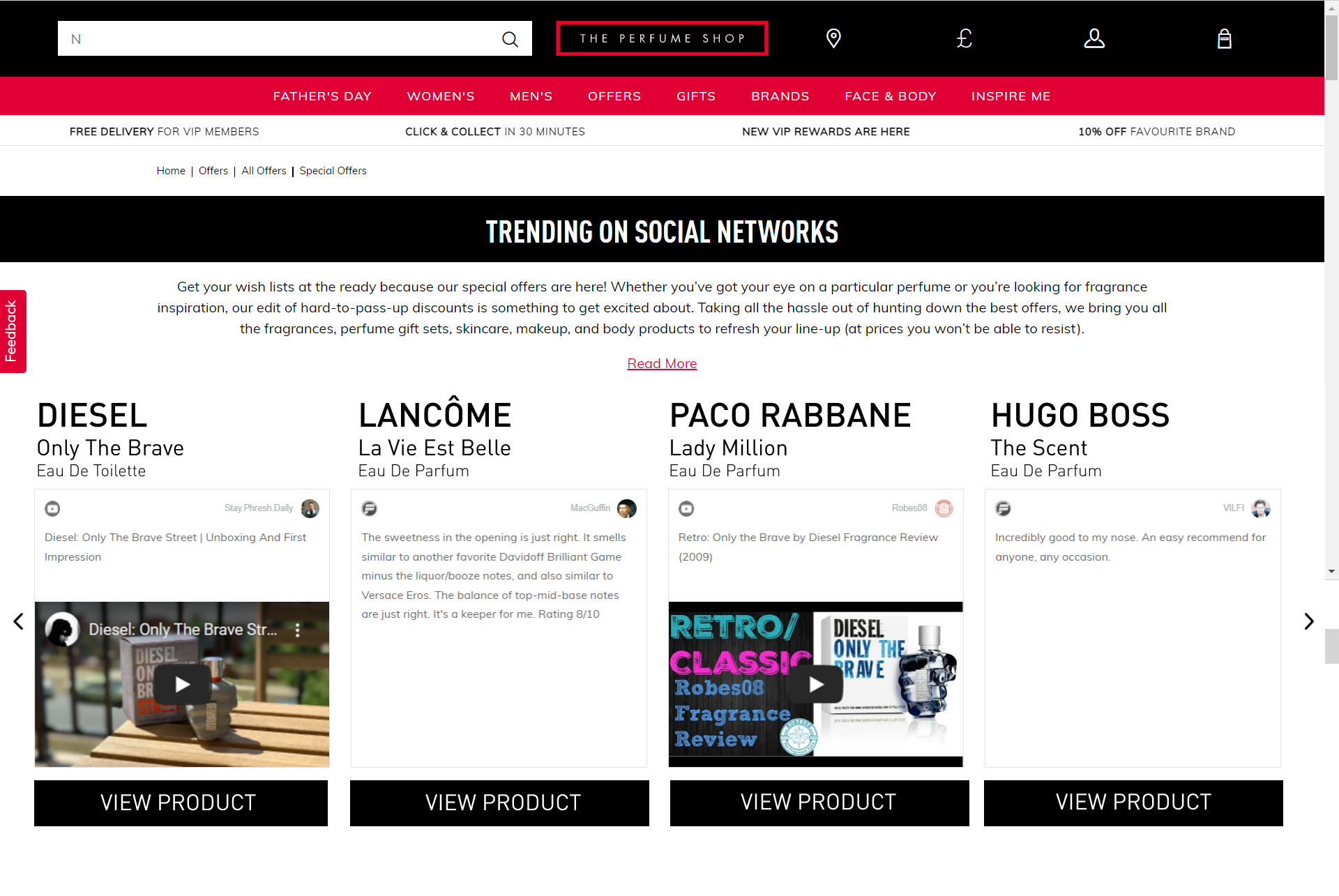
identified an opportunity to transform live social trends into a product-discovery experience. I led the development of a carousel that connected products currently trending on social media with relevant customer photos, videos and conversations.
Customers could discover what people were talking about at that moment, explore the related UGC and move directly to the product page.
In an A/B test, customers who interacted with the carousel purchased 6.5% more items than customers who did not interact with it.



Social Video Gallery
Bringing real social videos into the native product experience.
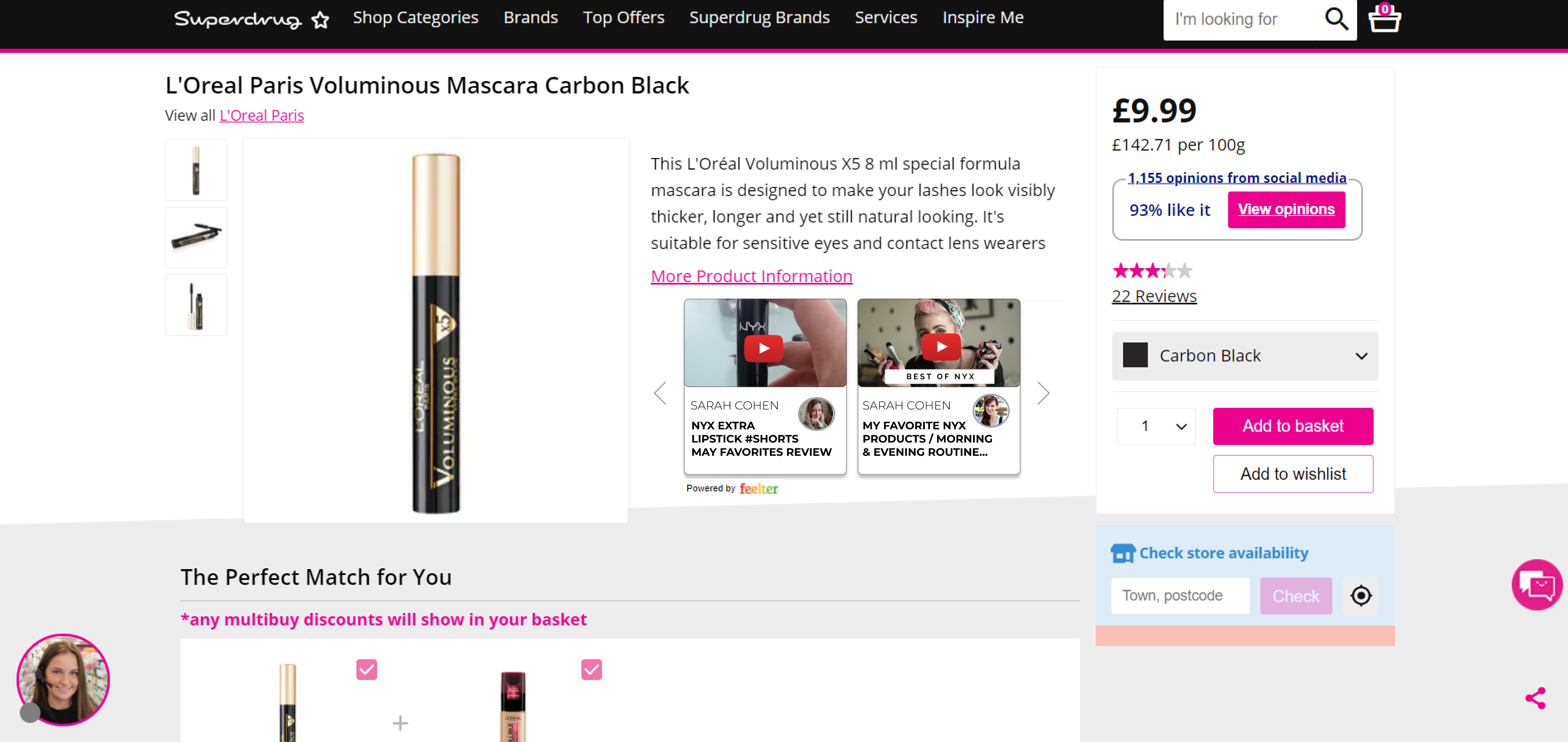
We created a video-only plugin that added relevant social media videos directly to each product’s existing image gallery.
Instead of placing UGC in a separate section lower on the page, videos became a natural part of how customers explored the product.
Customers who interacted with the video gallery showed a 3% higher conversion rate.
This showed that the location and format of UGC mattered. Making authentic content more visible and easier to explore helped customers feel more informed and confident.
In-Store Social Discovery
Bringing the social shopping experience into physical stores.
I also developed an interactive touchscreen concept for A.S. Watson stores. It allowed customers to browse products through social content, discover what was trending and explore how products were being used and discussed online.
The experience connected three environments that were usually separate: social media, e-commerce and the physical store.
It gave customers access to the richness of online product discovery while they were standing directly in front of the products.
The Impact
Our experiments showed a consistent relationship between richer social content, stronger engagement and better commercial performance:
- 6.5% more items purchased by customers who interacted with the trending-products carousel
- 3% higher conversion rate among customers who interacted with the social-video gallery
- New UGC experiences across digital and physical shopping journeys
- More engaging and authentic ways to discover and evaluate products
The results supported a broader product direction: UGC should not be treated as decoration or placed at the edge of the experience. When thoughtfully integrated, it can become an active part of discovery, evaluation and conversion


We transformed UGC from content displayed beside a product into a product experience of its own.
Contents


Home

The Experimentation Approach
Build, test, learn and let behavior shape the next version.
We treated each new feature as a product experiment rather than assuming that more content would automatically produce better results.
We evaluated:
- Whether customers interacted with the experience
- Which types of social content attracted attention
- How UGC influenced product discovery
- Whether engagement continued to the product page
- How interactions affected basket size and conversion
The experiments helped us understand not only whether UGC worked, but where it worked, in which format and at what point in the journey.
Experimenting with New Ways to Shop Through UGC
Moving user-generated content beyond individual product pages and turning it into new shopping experiences.
A.S. Watson’s brands were already using Feelter to display social media content on individual product pages. The next question was: what else could UGC do?
I worked with the group to develop and test new products that used social content not only to support purchase decisions, but also to help customers discover products in entirely new ways.
My role: Chief Product OfficerClient: A.S. Watson GroupFocus: Product discovery, UGC and experimentationMethods: Prototyping, A/B testing and behavioral analysis
The Opportunity
UGC was helping customers evaluate products, but its potential went much further.
Customer photos, videos and opinions gave shoppers a more authentic view of individual products. However, the experience was mostly limited to content displayed on product pages.
We wanted to explore how social content could support the entire shopping journey, from discovering what was currently popular to making a more confident purchase decision.
Instead of treating UGC as an additional content block, we began treating it as the foundation for new products and features.
My Role
I turned business needs and customer behavior into testable product concepts.
I worked with A.S. Watson stakeholders to understand the needs of its different brands, identify opportunities and translate them into new digital and in-store experiences.
My work included:
- Product discovery and concept development
- Stakeholder interviews and requirements
- User flows and interactive prototypes
- Product and UX design
- Collaboration with developers and client teams
- Experiment design and A/B testing
- Analysis of engagement and conversion
Each product started with a hypothesis, was developed into a working experience and was then tested with real customers.
Trending Products Carousel
Turning live social trends into product discovery.
identified an opportunity to transform live social trends into a product-discovery experience. I led the development of a carousel that connected products currently trending on social media with relevant customer photos, videos and conversations.
Customers who interacted purchased 6.5% more items.
Customers could discover what people were talking about at that moment, explore the related UGC and move directly to the product page.
In an A/B test, customers who interacted with the carousel purchased 6.5% more items than customers who did not interact with it.
The experiment demonstrated that social trends could do more than generate attention, they could create a new and commercially valuable path to product discovery.
Social Video Gallery
Bringing real social videos into the native product experience.
We created a video-only plugin that added relevant social media videos directly to each product’s existing image gallery.
Instead of placing UGC in a separate section lower on the page, videos became a natural part of how customers explored the product.
Customers who interacted with the video gallery showed a 3% higher conversion rate.
This showed that the location and format of UGC mattered. Making authentic content more visible and easier to explore helped customers feel more informed and confident.
In-Store Social Discovery
Bringing the social shopping experience into physical stores.
I also developed an interactive touchscreen concept for A.S. Watson stores. It allowed customers to browse products through social content, discover what was trending and explore how products were being used and discussed online.
The experience connected three environments that were usually separate: social media, e-commerce and the physical store.
It gave customers access to the richness of online product discovery while they were standing directly in front of the products.
The Experimentation Approach
Build, test, learn and let behavior shape the next version.
We treated each new feature as a product experiment rather than assuming that more content would automatically produce better results.
We evaluated:
- Whether customers interacted with the experience
- Which types of social content attracted attention
- How UGC influenced product discovery
- Whether engagement continued to the product page
- How interactions affected basket size and conversion
The experiments helped us understand not only whether UGC worked, but where it worked, in which format and at what point in the journey.
The Impact
Our experiments showed a consistent relationship between richer social content, stronger engagement and better commercial performance:
- 6.5% more items purchased by customers who interacted with the trending-products carousel
- 3% higher conversion rate among customers who interacted with the social-video gallery
- New UGC experiences across digital and physical shopping journeys
- More engaging and authentic ways to discover and evaluate products
The results supported a broader product direction: UGC should not be treated as decoration or placed at the edge of the experience. When thoughtfully integrated, it can become an active part of discovery, evaluation and conversion







We transformed UGC from content displayed beside a product into a product experience of its own.
Contents
Back To Homepage |

Experimenting with New Ways to Shop Through UGC
Moving user-generated content beyond individual product pages and turning it into new shopping experiences.
As Feelter’s CPO, I led the development and experimentation of new UGC powered shopping experiences for A.S. Watson brands.
The group was already using Feelter’s content on individual product pages.
my goal was to explore what else UGC could do across the shopping journey.
My role: Chief Product OfficerClient: A.S. Watson GroupFocus: Product discovery, UGC and experimentationMethods: Prototyping, A/B testing and behavioral analysis
The Opportunity
UGC was helping customers evaluate products, but its potential went much further.
Customer photos, videos and opinions gave shoppers a more authentic view of individual products. However, the experience was mostly limited to content displayed on product pages.
We wanted to explore how social content could support the entire shopping journey, from discovering what was currently popular to making a more confident purchase decision.
Instead of treating UGC as an additional content block, we began treating it as the foundation for new products and features.
My Role
I turned business needs and customer behavior into testable product concepts.
I worked with A.S. Watson stakeholders to understand the needs of its different brands, identify opportunities and translate them into new digital and in-store experiences.
My work included:
- Product discovery and concept development
- Stakeholder interviews and requirements
- User flows and interactive prototypes
- Product and UX design
- Collaboration with developers and client teams
- Experiment design and A/B testing
- Analysis of engagement and conversion
Each product started with a hypothesis, was developed into a working experience and was then tested with real customers.
Trending Products Carousel
Turning live social trends into product discovery.
identified an opportunity to transform live social trends into a product-discovery experience. I led the development of a carousel that connected products currently trending on social media with relevant customer photos, videos and conversations.
Customers who interacted purchased 6.5% more items.
Customers could discover what people were talking about at that moment, explore the related UGC and move directly to the product page.
In an A/B test, customers who interacted with the carousel purchased 6.5% more items than customers who did not interact with it.
The experiment demonstrated that social trends could do more than generate attention, they could create a new and commercially valuable path to product discovery.
Social Video Gallery
Bringing real social videos into the native product experience.
We created a video-only plugin that added relevant social media videos directly to each product’s existing image gallery.
Instead of placing UGC in a separate section lower on the page, videos became a natural part of how customers explored the product.
Customers who interacted with the video gallery showed a 3% higher conversion rate.
This showed that the location and format of UGC mattered. Making authentic content more visible and easier to explore helped customers feel more informed and confident.
In-Store Social Discovery
Bringing the social shopping experience into physical stores.
I also developed an interactive touchscreen concept for A.S. Watson stores. It allowed customers to browse products through social content, discover what was trending and explore how products were being used and discussed online.
The experience connected three environments that were usually separate: social media, e-commerce and the physical store.
It gave customers access to the richness of online product discovery while they were standing directly in front of the products.
The Impact
Our experiments showed a consistent relationship between richer social content, stronger engagement and better commercial performance:
- 6.5% more items purchased by customers who interacted with the trending-products carousel
- 3% higher conversion rate among customers who interacted with the social-video gallery
- New UGC experiences across digital and physical shopping journeys
- More engaging and authentic ways to discover and evaluate products
The results supported a broader product direction: UGC should not be treated as decoration or placed at the edge of the experience. When thoughtfully integrated, it can become an active part of discovery, evaluation and conversion
The Experimentation Approach
Build, test, learn and let behavior shape the next version.
We treated each new feature as a product experiment rather than assuming that more content would automatically produce better results.
We evaluated:
- Whether customers interacted with the experience
- Which types of social content attracted attention
- How UGC influenced product discovery
- Whether engagement continued to the product page
- How interactions affected basket size and conversion
The experiments helped us understand not only whether UGC worked, but where it worked, in which format and at what point in the journey.
We transformed UGC from content displayed beside a product into a product experience of its own.
Contents
Read More

Read More
Back To Homepage |